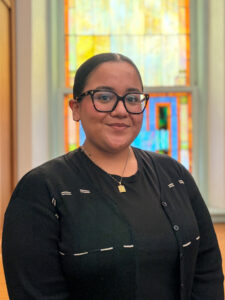
Emily Puentes is a long-time resident of our beautiful state of Texas! She was born in Matamoros, Tamaulipas but moved to Brownsville at a young age, propelling her desire to study the history of the state. She is currently a graduate student at the University of Texas Rio Grande Valley pursuing a Master of Arts degree in History with a focus on borderlands and immigration history. Emily has spent her summer working on an exhibit at Casa Navarro in San Antonio with Antonio Coffee and Crystal Dominguez.
This summer I have had the privilege of preserving the history of our state through the story of a true Tejano, Jose Francisco Ruiz. My assignment as an intern for the Preservation Scholars Program with the Friends of the Texas Historical Commission was to research and create an exhibit about Jose Francisco Ruiz, which will be displayed at Casa Navarro State Historic Site. Jose Francisco Ruiz was one of two native Tejanos to sign the Texas Declaration of Independence. So far, this project has shown me how much care and dedication it takes to put history out for the public.
Having worked in the public history field for two years now, I believed that creating an exhibit on my own would be quick. However, my project for Casa Navarro has taught me that working on research and exhibit publication takes time and requires continuous dedication. As a researcher, discipline and a clear mind are required to look at the same materials for days on end. Patience is needed to look through documents, books, articles, databases, archives, and libraries whose information may overlap. I’ve found that although overlapping facts are repetitive, they are best for public history research because they reinforce the authenticity of the information, and the knowledge needed to put together an exhibit. As the researcher for this project, I consider myself a public servant in charge of digesting the information found in books, archives, and other materials to piece together the life story of Francisco Ruiz for the public to learn about. I learned from a very knowledgeable archivist from the Bexar County Archive that the public wants to know, they just don’t know where to start.
Beyond the public history aspect, researching the life of Francisco Ruiz reminded me how complex the history of our state is. I started my research on Ruiz with the help of a book provided by my supervisors, Antonio Coffee and Crystal Dominguez. They helped me kickstart the research process with Art Martinez de Vara’s Tejano Patriot: The Revolutionary Life of Jose Francisco Ruiz, 1783-1840. Through this book, I was reminded of the changes that Texas has undergone, and I truly got to appreciate how my subject, Francisco Ruiz, was able to navigate through these challenges of the time. It also reminded me that preserving history is incredibly important even if it shows the good, the bad, and the ugly. Learning about Francisco Ruiz has shown me that the struggle for Texas independence was not an overnight change instigated by a single party, but rather a conscious effort led by multiple ideologies and parties who wanted to see change enacted. It is truly fascinating to see all the colors found in a single story and it is truly a privilege to build the history of our state through the story of one person for the public to see.
This post is part of our blog series “Scholars Speak,” which features writing from our 2026 cohort of Preservation Scholars. Click the link to learn more about this donor-funded program, which expands the range of perspectives represented in the Texas historical narrative by placing students from historically underrepresented communities in paid, 10-week summer internships with the Texas Historical Commission.