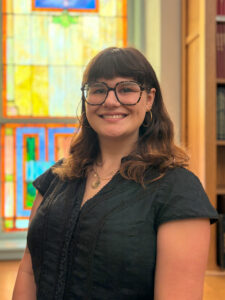
 Angelica Mock is currently a rising junior double-majoring in History and Anthropology at Wesleyan University in Middletown, CT. She was born in Florida, raised throughout the southern United States, and is now a proud Texan. As a Preservation Scholar Angelica has worked on the Uncovering Undertold Local History Project with Alicia Costello in the History Programs Division.
Working on the Uncovering Undertold Local History in the Texas Historical Commission’s Historical Marker Program is not just a labor of love, but a labor of community and connection. Like any research project, it relies on the work that hundreds of people have done before you, years before you, and in places you wouldn’t have thought to look. Before coming to the Texas Historical Commission, I was completely unaware of the depth of those connections that are so important to the preservation of local history. In particular, the Undertold Markers program is a project where the culmination of those connections and efforts contribute so much, and the markers wouldn’t be the same without it.
In the first couple of days of my position, I was completely overwhelmed by all the divisions, teams, and organizations that made up an agency that I had wrongly assumed to be only a handful of people. Acronyms like CHC, HPD, and HSD made no sense, but I knew they carried some sort of bureaucratic importance. It wasn’t until I started researching and writing aspects of my projects that I realized the true importance of the people behind the acronyms. With the addition of welcome meetings with all the divisions (thank you Olivia and Traci!), all the pieces were coming together and something that I thought was one person’s job, or even interest, suddenly became a group of five.
Undertold Markers are a special product of connections between county historical commissions and the various other divisions that make up the THC. Without the help of the people that make up the more local-facing organizations, individuals who hold the knowledge of undertold stories would not have the same opportunities or resources to tell their story. Telling history is as much, if not more, personal than factual, and that really shines through in the work that is conducted.
This post is part of our blog series “Scholars Speak,” which features writing from our 2026 cohort of Preservation Scholars. Click the link to learn more about this donor-funded program, which expands the range of perspectives represented in the Texas historical narrative by placing students from historically underrepresented communities in paid, 10-week summer internships with the Texas Historical Commission.