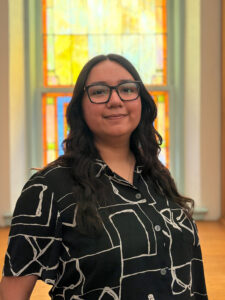
 Anahisa Rodriguez is from Weslaco, Texas and proud to call the Rio Grande Valley home. Currently, she is a graduate student at UT Austin pursuing a Master of Science in Information Studies with a focus on Archives & Preservation. As our Larry Oaks Scholar, Anahisa has worked on the Archeology Division Library Project with Ryann Ramirez and Donald Firsching in the Archeology and IT Divisions respectively.
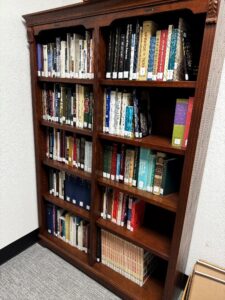
This summer, I’ve had the pleasure of working with the Texas Historical Commission (THC) on the Archeology Division’s Library Project. Having frequented libraries my entire life, I came into this internship with a deep love and respect for these communal learning spaces. However, the Archeology Division’s library is unlike any I’ve encountered before, posing both unique discoveries and challenges. Working on this project, I’ve gained a new perspective on Texas history and developed a newfound appreciation for all that librarians do.
The Archeology Division’s library is comprised of a niche collection. Its shelves are lined with monographs, dissertations, research journals, unpublished archeological reports, and more. Such a collection is best equipped to serve the THC’s Archeology Division staff and volunteers. Nevertheless, I’ve found myself pleasantly surprised by how much of the library’s content extends to other fields of study as well. In my time here, I’ve come across publications focused on anthropology, history, zoology, and beyond. As such, this library reflects an archeologist’s perspective grounded in Texas history as told by our land, artifacts, and bones.
Furthermore, in addition to ascertaining the scope of the collection, my task as a Preservation Scholar is to organize the Archeology Division’s library. This entails cataloging the library’s holdings to improve user accessibility physically and digitally. Prior to this project, however, I’d never given much thought to call numbers outside of their use for locating materials. Now, having to apply these unique identifiers to an entire library, I’ve learned the nuances of the Library of Congress classification system. Subsequently tweaking this system to create specialized call numbers for unpublished materials has likewise been an enlightening experience.
Ultimately, this opportunity has reinforced my belief that libraries, by their very nature, function as repositories of collective memory. The memory of this particular library highlights the interdisciplinary crossroads between archeology, history, and education. Yet, this wealth of knowledge is useful to nobody if it’s not navigable. Thus, my hope as I continue to work on this project is that the newly organized library will be of use to the Archeology Division and all THC affiliates who’d like to indulge their curiosity.
This post is part of our blog series “Scholars Speak,” which features writing from our 2026 cohort of Preservation Scholars. Click the link to learn more about this donor-funded program, which expands the range of perspectives represented in the Texas historical narrative by placing students from historically underrepresented communities in paid, 10-week summer internships with the Texas Historical Commission.