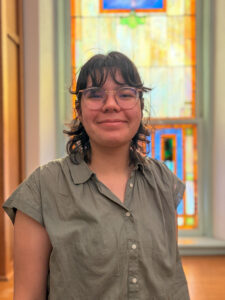
Fabiana Bracho is a third-year history and museum studies student at the University of Texas at Austin. Her interests include historic preservation, archival studies, and Latin American history. As our Larry Oaks Scholar, Fabiana is working on the Sam Bell Maxey 78 RPMs Project with Stacie Flood and Anne Ruppert at the Sam Bell Maxey House in Paris, Texas.
On the second week of my internship at the Sam Bell Maxey House (SBMH) in Paris, TX, where I have been cataloging their collection of 78 RPM shellac records that belonged to Maxey’s great-nephew and his wife, our collections room experienced a water leak. The most affected artifact was a poofy 1950s dress with many layers. Our Regional Collections Manager, Anne Ruppert, instructed me on the procedures necessary to preserve the impacted textiles: rotate them daily, stuff the layers with paper towels that are replaced twice a day, and lay them flat on acid-free foam and tissue. Seeing how intensively we cared for textiles, some of which only got a couple of drops of water on them, enlightened me to the great care preservationists have for protecting public history.
When I talk to people who don’t have a big interest in history, I tend to notice a repeat perception of museums as the gatekeepers of knowledge and materials. They can view the restricting cords and the “Do not touch” signs as a slight and an expression of power over the visitors. However, I can easily say the crew here at SBMH are working overtime to subvert this notion. Our educator Elana Barton has implemented various ways to involve the public as much as possible within the house. As guests walk around the ornate rooms with delicate artifacts throughout, they’ll also see an invitation to play with Victorian toys, including a zoetrope, a stereoscope, and a thaumatrope, all of which revolve around optical illusions. I have also been an excited helper in her programming for children, like a tie-dye event using natural dyes she made herself. Events like this reach out to those in the community who may not be fascinated by the story behind a 19th century home but still find themselves learning history through more creative means.
Recently, the other scholars and I were given the opportunity to speak with Francisco Guajardo, CEO of the Museum of South Texas History in Edinburg, Texas. He provided anecdotes that highlighted how the public trusts institutions like ours to not only protect their emotionally significant materials that they have donated but also utilize them to enrich the surrounding community. I’ve seen how the people at SBMH prioritize public access to our materials. As our site manager Stacie Flood explained to me, if someone asks us to look for a certain artifact, we have a responsibility to help them because our collection belongs to the people of Texas. My time here so far has taught me about the major advantage that small museums have over larger institutions: their ability to touch the hearts of individuals in their respective communities by exhibiting their regional and/or familial history. Visitors here see their town or even their relatives reflected in the work we do, and that impact we have has opened my eyes to the career possibilities in the museum field beyond institutions considered household names.
This post is part of our blog series “Scholars Speak,” which features writing from our 2026 cohort of Preservation Scholars. Click the link to learn more about this donor-funded program, which expands the range of perspectives represented in the Texas historical narrative by placing students from historically underrepresented communities in paid, 10-week summer internships with the Texas Historical Commission.